
What the GPI Really Says

“A nation that continues year after year to spend more money on military defense than on programs of social uplift is approaching spiritual death.” - Martin Luther King Jr.
Every year the Global Peace Index comes out I shake my head and I’m reminded of Jeff Daniel’s iconic response to a college students question in the premier episode of The Newsroom.
Yes, there was a time when this country solved problems instead of just arguing about whose fault they are. When sacrifice for the common good wasn’t considered naive. But that was a long time ago.
The new Global Peace Index just came out. It’s produced by the Institute for Economics and Peace. They measure 163 countries on how peaceful they are. Three domains. Safety and security, ongoing conflict, and militarization. You know where the USA ranks?
132nd.
That puts us behind Egypt. Behind Vietnam. Behind China, a country with actual government oppression, and we’re still more chaotic than they are. We’re between the Democratic Republic of Congo and Cameroon. The country that invented the internet and landed on the moon now ranks 132nd in peace.
Portugal is 7th. Canada is 11th. Iceland is 1st. Japan is 17th. Germany is 20th. France is 86th. France, the country Americans love to joke about surrendering, is 46 places ahead of us.
But here’s what the numbers are really telling us, and it’s not just that we have too many guns or spend too much on the military. Those are symptoms. The disease runs deeper. America has an optimization problem. We’ve built every system in this country to produce winners and losers instead of collective wellbeing. We don’t just value individualism. Plenty of individualist countries rank near the top of the peace index. We value a specific kind of competitive individualism where my gain requires your loss, where status is zero sum, where being great means being greater than someone else.
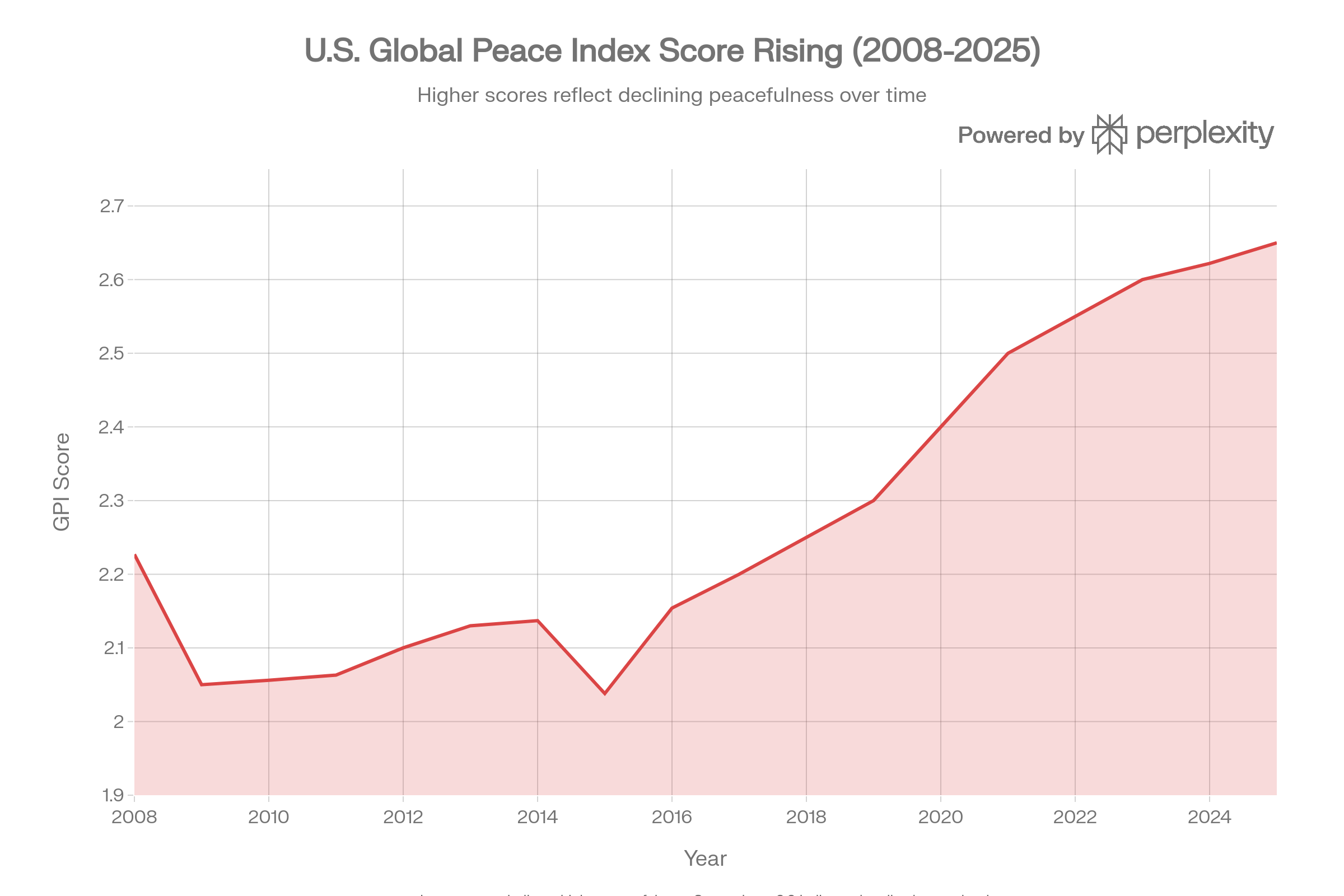
Look at the chart. That line going up? That’s our peace score getting worse every single year. From 2.2 in 2008 to 2.6 in 2024. Higher scores mean less peaceful. We are measurably, quantifiably becoming a less peaceful country every single year. And it’s not because we keep making bad choices. It’s because our systems are working exactly as designed.
You want to know the really embarrassing part? We spend 916 billion dollars a year on the military (read the quote from MLK at the opening of this article again…). That’s more than the next nine countries combined. We outspend China, Russia, India, the UK, Saudi Arabia, Germany, France, Japan, and South Korea put together, and we still rank 132nd in peace. Because military spending was never about making us peaceful. It was about making us dominant. Those are not the same thing. We optimized for the wrong variable.
We’re so militarized that we rank 161st out of 163 countries in the militarization category. The only countries more militarized than us are North Korea and Israel. North Korea! A country where most people don’t have electricity! And we’re right there with them buying bombs.
And you know what all that military spending gets us? Dominance. Not safety. Not peace. Not flourishing. Just the ability to project power anywhere on earth while our schools crumble and our bridges collapse and people can’t afford insulin. We built a machine that produces winners on the global stage and losers at home, and then we wonder why home doesn’t feel peaceful.
But sure, we’re really good at bombs. We’re excellent at bombs. We’re the best bomb country in the world. Congratulations, America, you win at bombs.
Now let’s talk about why we can’t seem to stop, because this is where it gets uncomfortable.
Americans don’t just disagree with each other. We’ve organized our entire society around the premise that the other side is an enemy to defeat rather than a fellow citizen to persuade. This isn’t polarization as a bug in the system. This is polarization as the operating system. Our media is optimized for engagement through conflict. Our politics is optimized for mobilization through fear. Our social media is optimized for outrage because outrage drives clicks. Every institution that shapes how we think has been tuned to make us fight each other, and then we’re surprised when we fight each other.
In 2020, homicides spiked 30 percent. Thirty percent in one year. The pandemic closed schools, community centers, workplaces. All the social infrastructure that actually prevents crime just stopped existing. And then Americans did what our systems taught us to do when we’re scared. We bought guns. Millions of guns. Because in a country optimized for dominance, the answer to fear is always more power, never more connection.
The good news is homicides are back down now. About 16 percent lower in 2024 than they were in 2023. We’re celebrating that our murder rate is only twice the global average instead of three times. That’s where we are as a country. We’re proud that we’re only killing each other at double the normal rate.
And even though crime is actually down, Americans feel less safe than ever. That’s not irrational. When your entire information environment is designed to make you afraid, you’re going to be afraid regardless of what the crime statistics say. Fear is the product. Division is the product. Conflict is the product. Peace doesn’t generate revenue.
The Global Peace Index measures something called intensity of organized internal conflict. It’s how much your country is fighting with itself instead of actual external enemies. Our score has gotten worse every single year since 2016. By 2021, after the Capitol riot, we were scoring as bad as countries with actual armed insurgencies.
Think about that. We have Starbucks. We have Netflix. We have Amazon Prime. And our internal conflict score looks like a country in civil war. Because we’ve built systems that treat our fellow citizens as the enemy.
You want more? We have the fifth highest incarceration rate on Earth. The only countries that lock up more of their people are El Salvador, Cuba, Rwanda, and Turkmenistan. Those are our peers. We have 531 prisoners per 100,000 people. We’ve put 1.8 million Americans in cages. And we did it on purpose. We built prisons as a jobs program in rural communities. We created financial incentives for incarceration. We optimized for locking people up, and we got exactly what we optimized for.
Here’s what peaceful countries figured out that we haven’t. They optimize for different outcomes. They measure different things. America obsessively tracks GDP and military spending and stock prices and incarceration rates. We have dashboards for dominance. Portugal and Iceland and Canada track health outcomes and educational attainment and social trust and life satisfaction. They have dashboards for flourishing. You get what you measure. We measure dominance. We get dominance. They measure wellbeing. They get wellbeing.
We have more guns than people. We score terribly on the access to small arms indicator. Every other wealthy country looked at gun violence and said maybe we should have fewer guns. We looked at gun violence and said we need more guns to stop the gun violence. That’s not a policy failure. That’s the logical outcome of a culture that treats every problem as a dominance problem. If your only tool is power, every solution looks like more power.
And before you say this is all because of liberals, Republicans or whatever, let me remind you that this decline happened under both parties. Obama, Trump, Biden. Doesn’t matter who’s president. The systems keep producing the same outputs because the systems are designed to produce those outputs. Both parties operate within the same optimization function. Both parties accept the premise that America should be dominant rather than flourishing. They just disagree about the details.
You know what the worst part is? We can’t even see the problem clearly because we’ve been told a story about ourselves that makes peace feel like weakness. The frontier myth. The city on a hill. Manifest destiny. Leader of the free world. Every narrative we tell ourselves requires an enemy, a wilderness to conquer, an Other to be superior to. Peace isn’t heroic in the American story. It’s boring. It’s what happens when nothing important is happening.
Portugal doesn’t have that problem. Portugal isn’t telling itself a story about being the greatest country in the world. Portugal is just trying to build a good society for Portuguese people. That’s it. No manifest destiny. No global dominance. Just the quiet boring work of making life better for the people who live there. I know because I live there now. And the contrast is disorienting. People feel safe in ways Americans have forgotten is possible. Neighbors know each other. Old women walk home alone at night. Kids play in parks without parents hovering in fear. It’s not perfect. The conservatives are gaining ground, using immigration as the wedge the way they always do, trying to import the same fear and division that broke America. But it’s still better. It’s 125 places better. And most Americans will never know what they’re missing because they’ve never spent enough time outside the country to realize that the way we live isn’t normal. It’s just what happens when you optimize for the wrong things for long enough that you forget there was ever another option.
In 2011, we ranked 82nd and we had a chance. We could have kept improving. We could have changed what we optimize for. We could have started measuring what actually matters instead of what makes us feel powerful. We could have become more like Canada or Germany or Portugal.
But we didn’t. We couldn’t. Because our systems weren’t designed to produce peace. They were designed to produce dominance. And dominance is what they keep producing, even as it tears us apart.
Think about these two examples from recent weeks. Wanting to acquire Greenland because it looks like a good real estate deal. That’s the optimization function in action. A self governing territory full of human beings reduced to a line item on a balance sheet. Their autonomy doesn’t factor into the equation because the equation only measures our power, not their flourishing. It treats dominance as the goal and other people as obstacles or assets.
Then responding to European pushback with tariff threats on allies like Denmark and the Netherlands. Same algorithm, same variables. Power and coercion over cooperation and mutual benefit. Even inside NATO, even with our closest friends, we default to dominance because that’s what our systems are tuned to produce. Peaceful countries solve problems through boring diplomacy. We solve problems by reminding everyone how powerful we are.
The first step in solving any problem is recognizing there is one.
We’re 132nd in peace. We’re behind Egypt and Vietnam and China. We spend more on weapons than anyone in history and it’s made us dominant but not safe. We lock up more of our citizens than nearly any nation on Earth. We have more guns than people and more gun deaths per capita than any wealthy nation. We tried to overthrow our own government three years ago and half the country thinks that was fine.
The problem isn’t that Americans keep making bad choices. The problem is that our systems were built to optimize for dominance rather than flourishing, for winning rather than wellbeing, for being greater than rather than being good. Every institution from our media to our economy to our politics is tuned to produce conflict, and peace is just not something the algorithm knows how to generate.
But you know what? We’re probably not going to fix this. The systems that produce dominance instead of flourishing are the same systems that decide what gets fixed. The media companies profiting from division aren’t going to vote to end division. The politicians who won through combat aren’t going to restructure politics to reward cooperation. The defense contractors getting rich off 916 billion dollars a year aren’t going to suggest maybe we spend that money on schools instead. The people who benefit from the current algorithm are the same people who control the current algorithm. That’s not a design flaw. That’s the design.
We like to tell ourselves we did it before. Interstate highways. Public universities. Social Security. Medicare. The moon landing. But we forget the context. We built those things when the top marginal tax rate was 91 percent and unions represented a third of workers and the memory of the Depression made collective action feel necessary rather than naive. We built those things when elites were scared enough to share. That fear is gone now. The people running the algorithm have gated communities and private jets and bunkers in New Zealand. They don’t need the system to produce flourishing. They just need it to keep producing wealth for them specifically. And it does. Perfectly.
So no, we’re not going to become Portugal. We’re not going to climb back to 82nd place. We’re not going to start optimizing for the right variables because the people who would have to make that decision are the same people who benefit from the wrong ones. The algorithm will keep running. The peace index will keep dropping. And we’ll keep insisting we’re the greatest country in the world while the data says otherwise.
That’s what greatness looks like now. Not building things. Not solving problems. Not making life better for everyone. Just insisting loudly that we’re already great while everything measurable gets worse. Chest thumping as national policy. Flag waving as a substitute for functioning systems. Being greater than as a replacement for being good.
We’ve forgotten what actual greatness requires because we’ve been sold a version of greatness that doesn’t require anything from the people at the top. Just sacrifice from everyone else. Just belief from everyone else. Just votes from everyone else. The algorithm keeps running and the algorithm keeps producing exactly what it was designed to produce and the people it’s designed to benefit keep benefiting.
The numbers on the Global Peace Index are not going to change. The systems that created those numbers are not going to change. The people who profit from those systems are not going to allow them to change. That’s not pessimism. That’s just reading the data honestly instead of telling ourselves fairy tales about American reinvention.
Portugal is 7th though. And they didn’t get there by being exceptional. They got there by being ordinary. By building boring systems that produce boring outcomes like healthcare and education and social trust and people not killing each other at twice the global average. Nothing heroic. Nothing manifest. Just a functioning society that optimizes for its citizens rather than for dominance.
And before someone says Portugal is socialist like that word is supposed to end the conversation, let’s be clear about what Portugal actually is. It’s a market economy. It has private property and private businesses and stock markets and billionaires. It’s not Sweden. It’s not even France. It just decided that maybe people shouldn’t go bankrupt from getting sick and maybe kids should be able to go to college without drowning in debt and maybe the point of a country is for the people living in it to have decent lives. That’s not socialism. That’s just not being insane. The fact that we’ve been trained to hear “people shouldn’t die because they can’t afford insulin” and immediately think “socialism” tells you everything about how captured our thinking has become. We can’t even imagine normal anymore. We’ve been so propagandized by the people benefiting from the current algorithm that basic functioning government sounds radical to us.
We could learn something from that. But we won’t. Because learning from smaller countries would mean admitting we’re not already the greatest. And the algorithm can’t produce that admission. It’s not in the code.
Just saying.