
What If They Could Have Been Warned?

Last year my wife and I left the United States, and I want to be precise about why, because the weather had nothing to do with it. I watched billionaires route fortunes through PACs and personal gifts and walk out of the White House with favors. I watched agencies destroyed, USAID first among them, not because they failed the public but because they inconvenienced the men writing the checks, while the base was told a different story entirely. I watched generals fired for insufficient loyalty and an auditorium of commanders lectured about the enemy within. I watched a Supreme Court pave the road for a theory that makes one man the whole executive branch, research halted in midstream, brilliant people chased toward other flags, and a masked immigration force grow into something that answers, in practice, to no one but him. I watched the networks and the universities pay their tribute. And I watched most of my countrymen see none of it, not because they lack decency but because seeing it costs something, and the lives most people carry are heavy enough already.
Two of our friends reached the same conclusion and left too. Since we arrived we have met hundreds more Americans doing the same math. But the conversations I cannot shake are the other ones, the dinners with people who left Russia as Putin closed his fist and people who left Brazil in the Bolsonaro years. They listen politely while the Americans at the table explain what is happening back home, and then they say some version of the same quiet sentence. We know. We watched this once already, and we also thought we had more time.
We left behind friends and family, most of whom rejected our reasons while blessing our retirement, delighted we could land somewhere so beautiful, unconvinced there was anything to flee. A few sent something colder than disagreement. We understood it, and we let it go. But their reaction is the reason I wrote this note today, because it raises a question I could not answer from instinct alone, whether people like us are alarmists or simply early. So I went looking for the population that faced this question before anyone, the most thoroughly warned people in modern history, and I read their file from beginning to end.
If only someone had told the Germans what was coming, surely they would have acted. It is the kindest thing we can believe about them, and it is false. They were warned. They were warned constantly, specifically, in print and in courtrooms and on the radio, by people who turned out to be right about nearly everything. The story of Germany between 1928 and 1933 is not a story of silence. It is the story of the loudest, most accurate warning campaign in modern history, and of a nation that heard every word.
The Warners
Start with Carl von Ossietzky, who edited Die Weltbühne in Berlin and week after week documented the secret rearmament, the paramilitary rot, the judges who winked at nationalist murder. For printing true things, the republic convicted him of treason in 1931. Not the Nazis. The republic. The democracy punished the man exposing the men who would kill it, and respectable Germany nodded, because Ossietzky was shrill and damaged the country's reputation abroad. In Munich, Fritz Gerlich called the movement a plague and its leader a pathological liar, in headlines you could read across a train platform. Kurt Tucholsky had been warning for a decade in satire so precise it read like prophecy, and polite society decided the problem was Tucholsky. A statistician named Emil Gumbel simply counted. He proved with a decade of arithmetic that political killers from the right walked free while killers from the left hanged, which meant the courts had chosen a side years before anyone forced them. His own university drove him out in 1932, before any regime existed to demand it. And one man did better than warn. In 1931 a lawyer named Hans Litten, not yet thirty, put Hitler in a witness box and questioned him under oath for three hours, forcing him to choose between the legal party he performed for judges and the violent movement he ran in the streets. Kurt Schumacher stood in the Reichstag in 1932 and called the whole enterprise one long appeal to the inner beast in man.
America has this file too, and it opens in November 2020, when Chris Krebs, the official responsible for election security, stated that the vote had been the most secure in American history and was fired by tweet within days. In April 2025 a presidential order named him, personally, for federal investigation and suspended the clearances of everyone at the company that employed him, and Ossietzky would recognize the shape of that exactly. A companion order the same day targeted Miles Taylor, whose crime was a book. General Mark Milley, the chairman of the Joint Chiefs, used his retirement ceremony in September 2023 to remind the armed forces that they take no oath to a wannabe dictator, and a year later, in retirement, told Bob Woodward that the man he had served was fascist to the core. After the power changed hands his security detail and clearance were stripped and his portrait taken off the Pentagon wall, while the president mused that men like him were once shot. John Kelly, the retired Marine general who ran the White House, said the word fascist out loud before the election, and it moved fewer votes than the price of eggs. Liz Cheney traded her seat and her party for the plain truth and was excommunicated for it. And in the spring of 2025 three of Yale's most prominent scholars of fascism left for Toronto. The philosopher Jason Stanley, who wrote How Fascism Works, said plainly that he wanted to raise his children in a country not tilting toward dictatorship. The historian Marci Shore said the lesson of 1933 is that you get out sooner rather than later. Her husband, the author of On Tyranny, insisted he was not fleeing anything and had his own reasons, and I take him at his word.
The Hinge and the Emergency
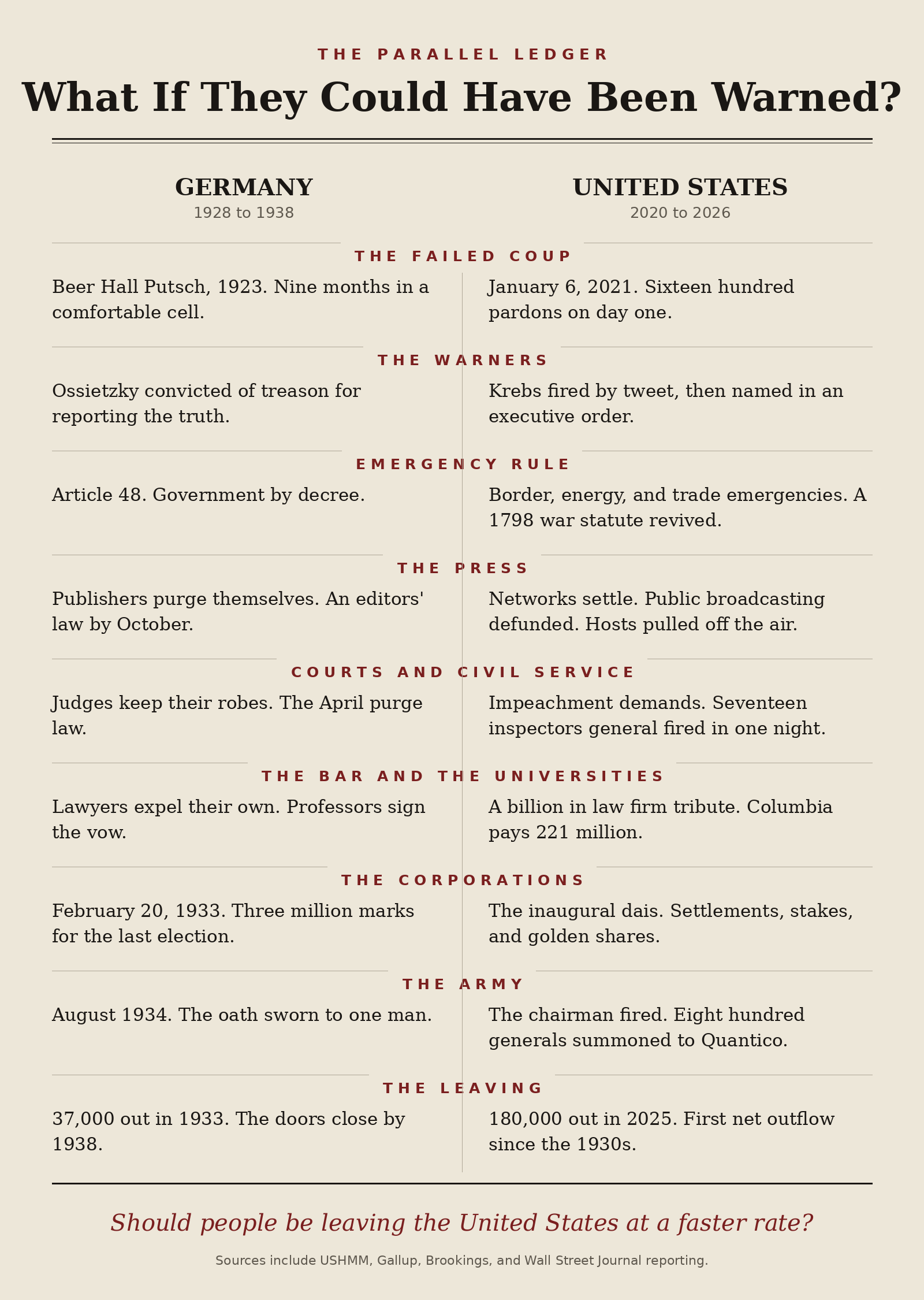
What Germany lacked was never information. It was the will to pay a price while the price was still small, and we can date the day the price stopped being small. On July 20, 1932, six months before Hitler, Chancellor Papen deposed the elected government of Prussia by decree. Prussia was democracy's fortress, two thirds of the country, commanding its largest police force, backed by millions of Iron Front members who had drilled for exactly this moment. The interior minister announced he would yield only to force. Force arrived as one officer and a few soldiers, and he yielded. The unions ran the numbers on a general strike and filed a lawsuit instead. Every judge, editor, and general in Germany absorbed the lesson in an afternoon. These people will not fight. Proceed. In November the Nazi vote actually fell by two million, and precisely because the movement looked broke, the gentlemen around the president judged it safe to bring its leader inside and harness his crowds. Within two months, Papen promised, they would push him into a corner until he squeaked. Then the Reichstag burned on the night of February 27, 1933, the decree suspending every civil liberty was signed by morning, Ossietzky and Litten were dragged from their beds before dawn, and in March a parliament thinned by arrests voted to abolish itself, one man, Otto Wels, rising to say you may take our lives and our freedom but never our honor.
An American mob stormed its own parliament in January 2021 to overturn a count, and the system's first instinct was the Weimar one, prosecute some foot soldiers, restore the leader to polite society within a season. Four years later the pardons erased even that, sixteen hundred of them signed in the first hours of the new term, the putsch reclassified as patriotism, the Proud Boys chairman and the Oath Keepers founder walking out of decades long sentences into hero's welcomes. Then came governance by emergency. A border emergency declared on day one, an energy emergency, a trade emergency under a 1977 sanctions law invoked to tax the entire world by signature, and the Alien Enemies Act of 1798, a statute written for declared wars, invoked in March 2025 to remove Venezuelans without hearings, 137 of the 238 men flown that weekend to a Salvadoran terrorism prison that held them not under any sentence but because the administration paid El Salvador to take them, some selected by their tattoos. The strategy is speed, act faster than courts can rule and let the rulings arrive after the facts are irreversible. Papen believed proximity would tame the radical. So did the men who spent 2021 through 2024 assuring donors he could be managed.
The Press
The German press did not have to be seized, because most of it coordinated itself. The nationalist Hugenberg already owned the wire service and the newsreels. The publishers' association expelled its own members before anyone demanded it, editors discovered an enthusiasm they had not possessed in February, and by October a law made every journalist a licensed servant of the state, by which point the license merely formalized the surrender.
The American version arrived as invoices, and the names belong in the record. Disney's ABC paid fifteen million dollars in December 2024 to settle a defamation case over one George Stephanopoulos sentence that many of its own lawyers considered defensible. Paramount paid sixteen million in July 2025 over the routine editing of a 60 Minutes interview, a case first amendment scholars called unwinnable for the government, while the company's sale to David Ellison's Skydance sat waiting at the FCC, whose chairman, Brendan Carr, blessed the merger sixteen days after the check cleared. That same month CBS cancelled Stephen Colbert, the top rated host in late night, three days after he called the settlement a big fat bribe on his own air. In September, ABC suspended Jimmy Kimmel within hours of Carr telling a podcast that broadcasters could do this the easy way or the hard way, and the two largest station groups in the country kept Kimmel dark even after the network blinked. Congress clawed back the entire 1.1 billion dollar appropriation for the Corporation for Public Broadcasting in July 2025, ending federal support for PBS and NPR after nearly six decades and forcing the corporation to announce its own shutdown. The Associated Press was barred from the Oval Office for months over the name of a gulf until a judge ruled the exclusion unconstitutional. The Pentagon issued press rules so restrictive that virtually every outlet, Fox News included, surrendered its credentials rather than sign. And the owner of the Washington Post, a man holding billions in federal contracts, killed his paper’s presidential endorsement eleven days before the election, then narrowed its opinion pages to personal liberties and free markets weeks into the new term. No editors’ law was required. The checkbook worked.
The Judges and the Civil Service
The German judges kept their robes and their pensions. Gumbel's arithmetic had shown where their sympathies ran a decade early, and after January 1933 they applied the new decrees with the same solemn craftsmanship they had applied to the constitution, all the way down to the People's Court. The civil service was purged by an April law with a title about restoration, and the bureaucrats implemented their colleagues' removal because implementing was their job.
Here the American echo is still a contest, which matters. When Judge James Boasberg ordered the deportation planes turned around, the president called by name for his impeachment, and the Chief Justice issued a rare public statement to say that impeachment is not the answer to an adverse ruling. Orders are slow walked in the hope they expire, the government spending months explaining why it could not facilitate the return of one man it admitted deporting by mistake, and Justice Ketanji Brown Jackson has written in dissent that on the emergency docket the government somehow always prevails. Seventeen inspectors general were dismissed by late night email on a single Friday in the administration's first week. A reclassification scheme moved tens of thousands of career officials into fireable loyalty slots, an unelected billionaire's task force emailed two million federal workers an offer titled Fork in the Road, and the FBI was handed to a loyalist podcaster who purged the agents who had touched the leader's cases. Then came the indictments, James Comey and Letitia James, the former FBI director and the state attorney general who had won a fraud judgment against the president, both charged by Lindsey Halligan, a White House aide installed as US attorney days after her predecessor resigned rather than bring the cases, and a federal court later threw out the Comey indictment precisely because her appointment was unlawful. The robes have held better than Germany's but the pressure being pressed against them is the same.
The Bar and the Universities
The German bar purged itself in April 1933, Jewish lawyers expelled by their own colleagues, who absorbed the clients and said nothing. The universities needed no occupiers at all. Students burned the books while professors watched, and by November the professoriate had published a vow of allegiance signed by some of the most decorated minds in Europe, Heidelberg having already proven with Gumbel that it could purge without being asked.
Nine decades later, executive orders named American law firms one by one. Perkins Coie was first, for having represented the 2016 opponent. Paul Weiss came next, and its chairman flew to the Oval Office and bought peace for forty million dollars in donated legal work, a price that told the market what capitulation cost and thereby set it. Skadden, Willkie, Milbank, Kirkland, Latham, and the rest followed at a hundred million or more apiece, until the tribute pledged by the most prestigious partnerships in the country neared a billion dollars. The four firms that refused and sued, Perkins Coie, Jenner, WilmerHale, and Susman Godfrey, won every single case, which makes the capitulations the more damning. Columbia, its grants frozen and its accreditation and student visas held over the fire, agreed to pay the federal government two hundred million dollars over three years, plus twenty one million more, to make the investigations end. Harvard watched 2.2 billion frozen, sued, and won its money back in September 2025 from a judge who called the freeze unconstitutional retaliation, so the administration changed instruments and mailed nine universities a Compact for Academic Excellence, preferential funding in exchange for ideological commitments, which MIT was the first to decline. The Justice Department forced out the president of the University of Virginia as a condition of closing an investigation, and dozens of institutions quietly reorganized themselves to avoid being next.
The Corporations and the Unions
The industrialists were invited to a private meeting on February 20, 1933, three weeks into the new government, where Krupp and two dozen peers heard that this election would be the last for a hundred years, and they funded it with three million marks. Stability for silence, contracts for a little more. The unions attempted the deepest accommodation of all, marching in the regime's May Day parade to prove their patriotism, and the next morning stormtroopers seized every union office in Germany.
The American meeting was held in public, on the inaugural platform, Musk, Zuckerberg, Bezos, Pichai, Cook, and Altman arranged in a row ahead of the incoming cabinet, having donated their millions, killed their fact checking programs, and settled their lawsuits in advance, Meta for twenty five million dollars, X for ten. Amazon bought a forty million dollar documentary about the first lady. Apple's chief executive presented the president with a disk of glass mounted on a base of twenty four karat gold. The diversity programs that had blanketed corporate America vanished in a single season, Meta to McDonald's to Walmart to Target. And the favors flowed back as ownership, a golden share in US Steel, ten percent of Intel, a fifteen percent cut of chip sales to China, the state entering the shareholder registry the way it once entered German boardrooms, by invitation. The unions' turn came in March 2025, when an executive order stripped collective bargaining from most of the federal workforce in the name of national security, the largest single act of union busting in American history by its victims' count, while the labor board was paralyzed by firing its Democratic member mid term. They believed, as Krupp believed, that they were purchasing predictability. Krupp got twelve years of contracts and a family name that means slavery. The bill in the USA has not yet been presented.
The Army and the Oath
The German army was the last institution that could have ended it with a telephone call, and in August 1934 it swore its oath to the man instead of the constitution, a bargain sealed by a massacre the generals tolerated because the corpses included their rivals. From that morning, every officer's honor was mortgaged to one man's survival.
The American officer corps has sworn no such oath, but look at what it has watched. General CQ Brown, the chairman of the Joint Chiefs, dismissed without cause a month into the term, the chief of naval operations and the Coast Guard commandant with him, the top uniformed lawyers of three services fired in a single batch, and the director of the NSA removed after a conspiracy theorist visited the Oval Office carrying a list. In September 2025 roughly eight hundred generals and admirals were summoned from every command on earth to an auditorium at Quantico, where the secretary denounced woke garbage and the president described American cities as training grounds for the war from within. Troops then went to six of those cities over their governors' objections, and courts pushed most of them back out. Meanwhile, in the Caribbean, the military began sinking small boats on the president's say so, more than eighty people killed without a declaration, a hearing, or a released name, including, by multiple accounts now under congressional investigation, a second strike ordered on shipwrecked survivors. The oath still runs to the Constitution. The audience at Quantico noticed who was being auditioned.
The Machinery
It began with a boycott in April 1933, then registries, then dismissals, then the 1935 laws that unmade citizenship itself, then denaturalization lists in the official gazette, then, in November 1938, the glass in the streets and thirty thousand men taken to camps in a week. Each step was paperwork before it was violence, and each was legal by the time it happened, because the law had been rewritten to make it so.
The American machinery runs on quotas now, Stephen Miller's demand for three thousand arrests a day, executed by masked men who no longer show badges. A green card holder named Mahmoud Khalil taken from his pregnant wife for leading a protest. A doctoral student named Rümeysa Öztürk surrounded on a sidewalk by plainclothes agents over an opinion essay. A wrongly deported man named Kilmar Abrego Garcia whose return the government resisted for months after admitting its own error. Courthouse ambushes, a denaturalization task force at the Justice Department, an executive order against birthright citizenship, flights to the Salvadoran prison and to South Sudan, a detention camp in the Everglades that the ruling party marketed with alligator merchandise, a mother of three named Renee Good shot dead in her car in Minneapolis this January, and administrative subpoenas demanding that tech companies identify the neighbors who filmed it. No one has broken the nation's glass in a single night. The registries, the quotas, and the stripping of citizenship are the 1933 to 1935 layer, and that layer is running.
The Leaving
Which brings me to the part of the German story Americans know least, the leaving. Germany's Jews were neither passive nor blind. Roughly 37,000 left in 1933 alone, the clear eyed and the connected, people who took the first measures at face value. Then something human and terrible happened. The pace slowed. Through 1934 and 1935 many convinced themselves the fever would break, and thousands who had fled actually returned. The Nuremberg Laws stripped citizenship and still the majority stayed, because leaving meant abandoning a language, a business, a mother, a grave, and because the regime had made exit a form of confiscation, a flight tax of a quarter, currency rules that took most of the rest, prosperous families departing with ten marks and a suitcase. Then 1938, Austria annexed in March, the November pogrom, and doubt died. More than 110,000 scrambled out in two years, selling everything at a tenth of its value. And the world delivered its verdict at Evian in July 1938, where thirty two nations expressed profound sympathy and opened almost no doors, and off Miami in 1939, where a ship carrying nine hundred refugees was turned back within sight of the lights. When the Reich formally banned Jewish emigration in October 1941 the ban was nearly redundant. The doors had already closed from the outside. About 163,000 remained in Germany, and almost all of them were murdered. The arithmetic of the era is the coldest I know, and it runs on a simple rule. The price of leaving rose every year the danger did. A family that left in 1933 paid a quarter of everything it owned. A family that left in 1939 paid nearly all of it and started over with a suitcase. A family that waited past 1941 could no longer buy an exit at any price, because by then the trains ran in only one direction.
Now the American ledger, numbers only, because the numbers are doing something they have not done in ninety years. At least 180,000 American citizens moved abroad in 2025 by the Wall Street Journal's reconstruction from foreign arrival records, the largest outflow in decades, and Brookings calculates that net migration went negative, more people leaving than arriving, for the first time since the 1930s. Renunciations of citizenship, a few hundred a year for most of my life, approached five thousand. Gallup finds one in five Americans wanting to leave permanently, double a decade ago, and among women under forty five it is forty percent. Three quarters of the American scientists who answered a Nature survey said they were considering leaving, a French university opened a program called Safe Place for Science and drew hundreds of applicants within weeks, and Germany's Max Planck institutes reported American applications doubling. The American population of Portugal grew fivefold in five years. American arrivals in Ireland doubled in one. British citizenship applications set a record. The relocation conferences sell out ballrooms, and the attendees arrive with spreadsheets, not fantasies. And the doors are behaving as doors do. Portugal stretched its citizenship clock from five years to ten in May 2026. The queue formed, and the countries at the front of it have begun, politely, to lengthen the line.
A software engineer choosing Lisbon is not a family fleeing a race law, and pretending otherwise insults the dead. Most of today’s leavers cite costs and health care alongside politics. But that was true of Germany’s first wave too. The people who left in 1933 were not fleeing Auschwitz, which did not exist. They were reading a direction, not an outcome, and they left while leaving was merely expensive instead of impossible. Emigration is a leading indicator. It measures what informed people with options believe about the future, and the informed people with options, the scientists telling surveys they are looking abroad, the historians of fascism unpacking in Toronto, the families at the visa seminars, are betting against the American trajectory in the largest numbers since the year the Iron Front stood down.
Yet every suitcase packed carries an unspoken tragedy. The gravest danger to a wobbling democracy has always been demobilization. Every doctor who moves to Ireland, every lawyer who sits out the fight from a rented flat in Valencia, every family that surrenders its voter registration leaves behind a country slightly more vulnerable than they found it. Autocracy relies on the quiet exile of the capable. It does not need to convert its critics if it can convince them to clear the room. That is the paradox at the center of this, and it follows you across an ocean. Leaving is insurance for your children and a subsidy for the thing you flee, both at once. You buy safety for your family by subtracting your voice, your taxes, and your presence from the defense of everyone who cannot afford a passport. You leave the field to the people least equipped to survive what is coming, the vulnerable, the poor, the targeted, and you make the dark bet you fled that much likelier to pay. Exile is not a victory. It is a transaction, paid in guilt, for a peace that never feels fully earned.
The Question
So I end where the German file ends, with timing. The warnings were given there, magnificently, by people who paid everything, and they are given in America daily by people who have so far paid careers. In Germany the exits narrowed every single year while the reasons to use them grew, and the moment when everyone finally agreed it was time to go was the precise moment it stopped being possible. A hundred and eighty thousand Americans looked at their country last year, weighed their duty against their fear, and chose the door. We are part of that tally now, carrying both the relief of safety and the quiet grief of desertion. The honest question is not whether we overreacted, and it is not whether we were brave. The honest question is the one that remains for everyone still watching the clock.
Should people be leaving the United States at a faster rate?
We will know the answer to that question November 3, 2026…