
The Top 20% Have 59% of the Dollars, But the Bottom 80% Have 80% of the Votes

I sat there this morning staring at Emily Peck's column on my phone and saw what should have been obvious to me but wasn’t... She was talking about how the stock market is tearing upward while the job market rots from the inside out and it gave me that distinct metallic taste in your mouth that you get right before a car accident. It reminded me of reading Sorkin’s new book 1929 when the jazz was loud and the gin was cold but the smartest guys in the room were quietly moving their cash into gold bars and farmland.
Then I looked at the chart in her article from Moody's and the feeling went from a metallic taste to a pit in my stomach.
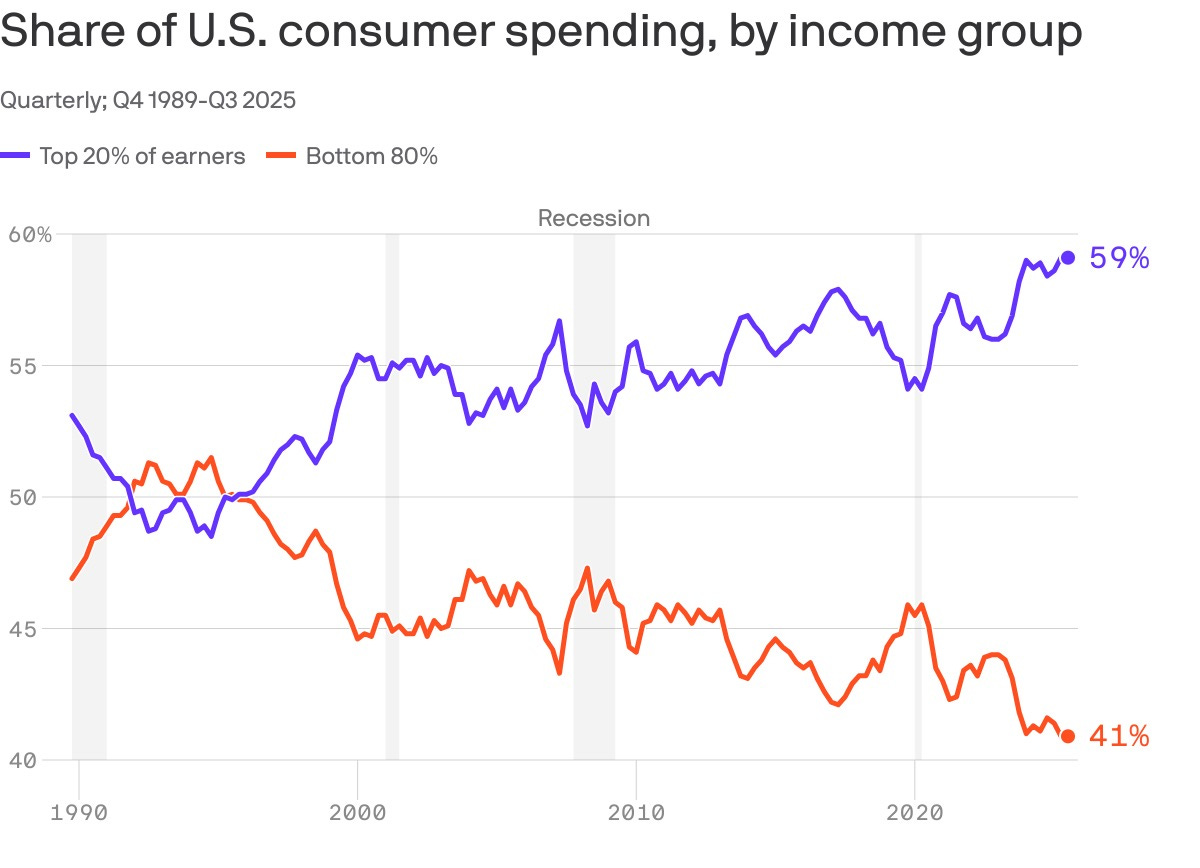
You are looking at a picture of a country that has quietly become two different economies sharing the same flag. Fifty nine percent of every dollar spent in this economy now comes from the top twenty percent of earners. That is not a typo and it is not a blip. It is a trend that has been building for a quarter century, accelerating through administrations of both parties, and it just hit a near record high. The bottom eighty percent of Americans, the vast majority of the country, now account for just forty one percent of consumer spending.
Let that sink in. The USA does not have a consumer economy anymore. We have what analysts once called a plutonomy, where GDP is increasingly just a measure of how many yachts and Nvidia shares and renovated kitchens the top quintile is buying while the folks in the bottom four quintiles are putting groceries on credit cards with eighteen percent interest rates.
The optimistic take, which you will hear from Bank of America and other institutional analysts, is that this is actually fine. The top twenty to forty percent of earners represent the bulk of spending by design in any modern economy, they will tell you. As long as their portfolios keep climbing and their home equity keeps compounding, consumer spending remains resilient and GDP keeps growing. The K shaped recovery can persist indefinitely.
Maybe they are right. Maybe this is just how mature economies work now and I am seeing ghosts where there are only shadows. But I keep coming back to one number that the optimists never mention.
Eighty percent.
The top twenty percent may have fifty nine percent of the dollars. But the bottom eighty percent still have eighty percent of the votes. And historically, when you get a gap this wide between economic power and political power, something eventually gives. The pressure does not just dissipate. It finds an outlet.
Look at the chart again. In 1990, the two lines were nearly touching. The top twenty percent had about fifty two percent of spending and the bottom eighty percent had about forty eight percent. It was not equal but it was close enough that you could squint and see one economy with a shared set of interests. By 2000 the lines started to diverge. By 2010 the gap was unmistakable. And now, in early 2026, the lines are further apart than they have ever been.
What happened in that same period politically? The rise of the Tea Party. Occupy Wall Street. Bernie Sanders nearly winning the Democratic nomination. Donald Trump actually winning the presidency. Twice. You do not have to be a political scientist to connect these dots. When eighty percent of the population watches their share of the economy shrink for thirty years, they start voting for people who promise to burn the system down.
And here is where the current political chaos becomes relevant. We now have an administration that thrives on disruption, ruling largely by executive action because a spineless Congress will not check it and a Supreme Court has handed it extraordinary immunity protections. The question is not whether this administration caused the spending divergence. It obviously did not. The trend predates it by decades. The question is what happens when you pour political gasoline on an economic fire that has been building for a generation.
I see three plausible paths forward and none of them are comfortable.
The first is what I would call managed decline. The administration uses its expanded powers to pressure the Fed into keeping rates artificially low, which keeps asset prices inflated for the portfolio class. The top twenty percent keep spending because their brokerage statements look great. The bottom eighty percent keep treading water, using credit to bridge the gap between stagnant wages and rising prices. GDP growth continues to look respectable on paper. But under the surface the economy becomes increasingly hollowed out, a kind of banana republic with fiber optic internet where the wealthy live in one country and everyone else lives in another. This is probably the most likely outcome because it requires the least active effort. It is just inertia with extra steps.
The second path is acute crisis. This is what happens if the administration's more chaotic impulses, the trade wars, the mass deportations, the institutional vandalism, actually shred the labor market fast enough to trigger a demand collapse. The bottom eighty percent are already tapped out. They have been funding consumption with debt, not income growth. If you hit them with a supply shock from tariffs at the same moment you hit them with a demand shock from job losses, the arithmetic gets very ugly very fast. The top twenty percent cannot spend enough to offset an eighty percent pullback. This is the scenario where the two economies stop politely ignoring each other and start actively colliding.
The third path is political correction. This would require either the current opposition to find some organizational coherence or for the sheer weight of economic misery to force the hands of whoever is in power. It is the only path that ends without either a whimper or a bang. But looking at the current state of American political institutions, I would not bet my retirement on it.
I want to be clear about what I am not saying. I am not saying the stock market is about to crash tomorrow. I am not saying you should liquidate your 401k and buy canned goods. The K shaped economy has proven remarkably durable precisely because the people with the most economic power also have the most political power and the most media power and the most ability to shape the narrative about what is normal and what is sustainable.
What I am saying is that this chart represents something more than an interesting economic data point. It represents a slow motion divergence between two Americas that increasingly do not recognize each other, do not shop at the same stores, do not live in the same neighborhoods, do not watch the same media, do not experience the same economy, and increasingly do not agree on basic facts about how the country works or who it works for.
The scary thing about that chart is not the blue line going up or the orange line going down. It is the silence in the widening gap between them. That is where the pressure has been building for thirty years. And pressure, in my experience, does not just disappear. It waits for a catalyst. In a political environment defined by chaos and grievance, catalysts are not exactly in short supply.