
Low Tide in Estoril

I walk to Homes Place gym daily and pass this stretch of coast in Estoril, and each time I slow without meaning to. The tide slides out and suddenly the beach is not really sand at all but a broad stone floor, patterned like an old courtyard, dark blocks fitted together as if someone laid them by hand. Then there is that narrow strip of concrete reaching toward the water, steady and plain, as if it has a job to do...
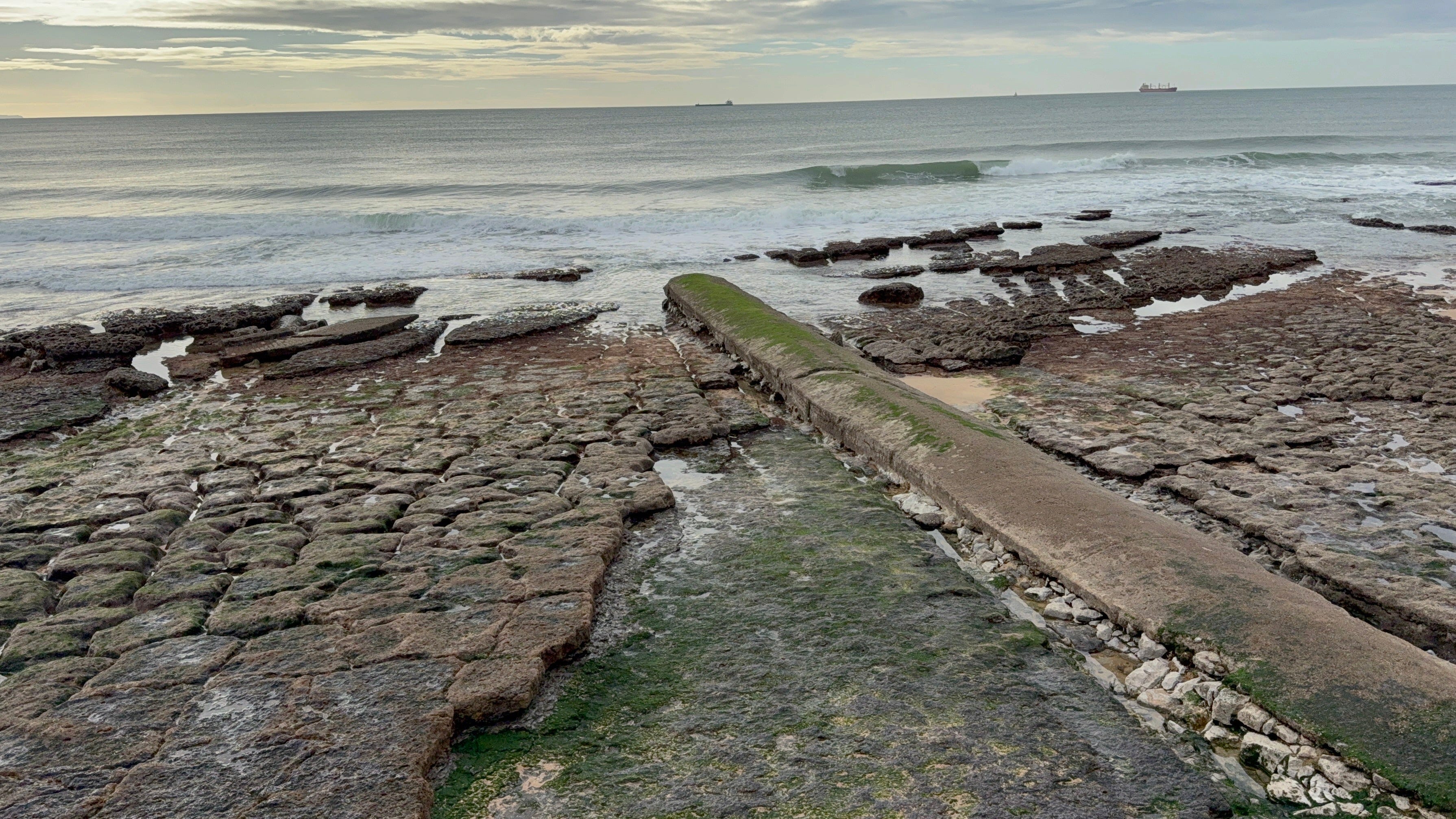
At first I took the rocks at face value, the natural roughness of a coastline, but the more often I passed the more deliberate they looked. The surface is broken into big squarish slabs with seams between them, and in the seams there are small pools that catch the sky. When the ocean is calm the pools sit perfectly still, and when the ocean is restless they flash with ripples and foam.
What I am seeing is the work of time and repetition. This coast is built from sedimentary layers that settled long ago and hardened into limestone. Those layers are not perfectly uniform, and over the years they have been bent, stressed, and cracked. The sea does not have to break an entire slab at once. It only has to find the weak places in the stone. Salt water pushes into the joints, sand grinds at the edges, and wave after wave uses the same lines of weakness until the seams widen and the blocks stand out. Over a long enough span the sea turns the surface into a low platform, almost level, because the high points get knocked down and the hollows get cleaned out.
The green stains on the stone are algae. At low tide the rock is exposed, damp, and sunlit, and a thin living film takes advantage of it. The sea leaves a signature even after it pulls back.
The concrete structure is a stormwater outfall. It collects rainwater runoff from the streets and buildings uphill and routes it across the tidal platform to discharge into the ocean. When it rains, water flows downhill. In an urban area that means water runs off roofs, streets, parking areas, and sidewalks. Without a controlled path, that flow would spread across the beach and rocks wherever gravity takes it, scouring random channels, undermining structures, and depositing debris unpredictably. The concrete channel gives the water a fixed route with a stable discharge point. It prevents erosion of the shoreline and keeps the runoff from pooling on the beach where people walk.
This is different from a sewage outfall, which typically extends much farther offshore and discharges treated wastewater underwater. What I am looking at handles surface runoff only.
Seeing it daily has changed how I read the whole place. The rocks look like nature, but they are a record of forces that have shaped this coast for thousands of years. The concrete looks like an interruption, but it is basic infrastructure, the kind of thing every coastal city needs to keep rainwater from tearing up the shoreline. Now when I pass on my way to Homes Place, I watch the tide reach into the cracks, then withdraw and leave the platform gleaming.