
Let’s Review Reality: Can Democrats Actually Take Back the House? The Senate? In the Midterms…
The models say yes. The ecosystem says not so fast

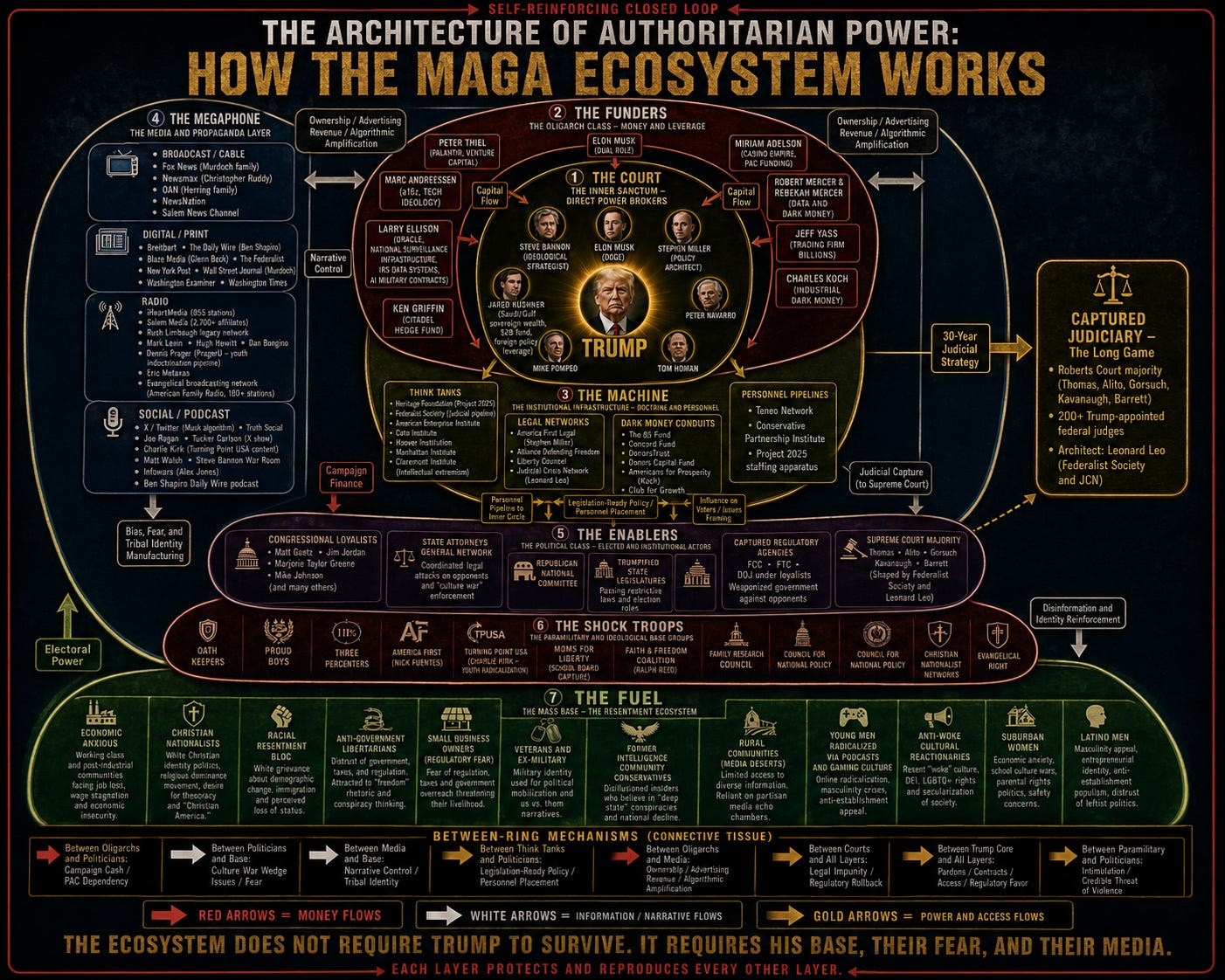
There is a version of this story that writes itself easily. Trump’s approval rating sits in the low to mid 30s, Pew has him at 34%, Marist at 37%. The economy is punishing working people. Special elections in districts that should be safely red have been flipping blue or running surprisingly close. The historical record is almost a law of physics: the president’s party loses ground in midterms. Since 1938, that record stands at 2-20. The Economist’s model, running 25,000 simulations, now gives Democrats a 98% chance of flipping the House. Prediction markets give them 73% odds on a full congressional sweep.
That version of the story is not wrong. It just isn’t complete.
Because what the polls and the prediction models measure is voter sentiment. What they do not fully account for is the architecture, that is the deliberate, layered, multi decade infrastructure that was built specifically to make voter sentiment matter less. Before you decide how hopeful to be, you need to look at the graphic above. Really look at it. Trace the arrows. Read the mechanisms at the bottom. Because what that map shows is not just who supports Trump. It shows how a system has been engineered to be resistant to exactly the kind of democratic correction that midterm elections are supposed to provide.
Let’s review reality, layer by layer.
The Numbers That Should Make Democrats Confident
Start with what is genuinely true. Democrats need a net gain of only three seats to take the House majority. They need four to flip the Senate, where 22 of the 35 seats up in 2026 are held by Republicans. History favors them. Special elections across 2025 and 2026 have been pointing sharply in their direction including a stunning 20 point over performance in a Michigan state Senate district that Kamala Harris carried by a single point in 2024. They flipped a district covering Mar-a-Lago itself, a 21 point swing in Palm Beach County that elected Democrat Emily Gregory in a district Trump carried by 20 points. Virginia and New Jersey delivered bigger than expected blue margins in their governor’s races.
A Democratic union machinist flipped a Texas state Senate seat in January in a district Trump carried by more than 17 points just two years ago. That is not a fluke. That is a signal.
And then there is the Latino data, which is the most striking new intelligence in this cycle. A sweeping bipartisan poll released last week by UnidosUS, the nation’s largest Latino civil rights organization, surveyed 3,000 registered Hispanic voters nationally, including 500 in Texas and samples across 32 competitive congressional districts. The findings are striking. Two thirds of Latino voters nationally disapprove of Trump’s job performance. In Texas, where Trump captured an estimated 55% of the Hispanic vote in 2024, a historic high water mark, his disapproval has reached 67%. Democrats now lead the generic House ballot among Texas Latinos by 54% to 28%. In southwest battleground districts, 42% of Latinos who voted for Trump in 2024 say they would not do so today.
“President Trump is erasing the very increase in support that he touted in the 2024 election,” said Clarissa Martinez, vice president of the Latino Vote Initiative at UnidosUS.
That is the wind at Democrats’ backs. It is real, and it is stronger than it looks on a generic ballot average.
But then you look at the Democratic Party’s own numbers and the wind gets complicated. As of this spring, only 28% of Americans view the Democratic Party favorably and the most recent CNN data puts it closer to 25%. The Wall Street Journal found 63% of voters holding an unfavorable view. Compared to 2018, the last time Democrats ran a midterm wave against Trump, their net favorability has dropped nearly 30 points. Republicans are also underwater, but the asymmetry matters: you can vote against the party in power without voting for the opposition. You can stay home. You can be insufficiently motivated to stand in line for two hours.
Two thirds of Democratic voters say their party faces major disagreements over priorities and direction. That is not a messaging problem. That is a structural problem, and structural problems do not get solved between now and November.
And the UnidosUS poll itself contains a warning that is easy to miss in the headline numbers. Democrats are not running away with Latino voters, they’re leading 54% to 27% nationally, but 19% remain undecided. As one analyst noted, Democrats are still underperforming the levels of Latino support they would need to be structurally successful. The coalition is moving. It has not arrived.
The Rigged Terrain: What SCOTUS and the Gerrymanders Did
Here is where we have to stop talking about sentiment and start talking about structure.
Look at the Captured Judiciary node in the map, that amber box sitting just outside Ring 5, connected by a gold arrow labeled “30-Year Judicial Strategy.” It represents one of the most consequential long game operations in American political history, built through the Federalist Society pipeline, funded through Leonard Leo’s dark money network, and now producing rulings that reshape the electoral terrain before a single vote is cast.
On April 29, 2026, the Supreme Court issued its ruling in Louisiana v. Callais. In a 6-3 decision along the precise ideological lines that Leo and the Federalist Society spent three decades constructing, the Court gutted Section 2 of the Voting Rights Act, the provision that for 60 years had been the primary legal tool for challenging racial discrimination in redistricting. Justice Kagan’s dissent declared Section 2 “all but a dead letter.” One legal scholar wrote simply: “Light a candle in memory of the Voting Rights Act, which died today, aged 60.”
What the ruling effectively said is this: racial discrimination in redistricting is now permissible as long as you call it partisan gerrymandering instead. That distinction has always been functionally meaningless in states where race and party affiliation map almost perfectly onto each other which describes most of the American South. The Court just made it legally meaningless too.
The consequences were immediate. Florida’s legislature, working in a special session called by Ron DeSantis, advanced an aggressively gerrymandered map designed to deliver up to four additional Republican seats even though Florida voters had passed a constitutional amendment banning partisan gerrymandering. DeSantis simply overrode the will of the voters. A DeSantis appointed judge allowed the map to stand.
Texas had moved first. At Trump’s personal urging, the Texas legislature redrew its congressional map in summer 2025 with the explicit goal of adding five Republican leaning seats. The map was enjoined by a federal district court in November. The Supreme Court stayed that injunction in December, reinstating the map for the 2026 primaries. The Captured Judiciary node at work. Missouri, Ohio, and Louisiana followed with their own redraws.
Democrats counter, gerrymandered in California, and redistricting expert Jonathan Cervas estimates the net partisan effect of all the new maps may actually produce a small net Democratic gain but that calculation does not account for what comes next, after Callais opens the door to further map challenges in states where minority voting strength had been legally protected. The Brennan Center called the ruling “the opening of a door” that could produce consequences “even more dramatic and if possible, more harmful” than what we have already seen.
But Callais was not operating alone. It was the judicial component of a 3 part suppression architecture being assembled in real time, all aimed at the same November election.
The second component arrived on March 31, 2026, when Trump signed his second executive order targeting mail in voting, the more aggressive follow up to a March 2025 order that 3 separate federal judges had already blocked. The new order directed the Postal Service to compile “state citizenship lists” of approved mail voters and refuse to deliver ballots to anyone not on those lists. It directed DHS and the Social Security Administration to build those lists from databases that voting rights experts immediately flagged as error prone and systematically likely to exclude legally registered voters such as disproportionately elderly, disabled, rural, and minority voters. Senator Alex Padilla put the exposure plainly: “Tens of millions of eligible voters could be prevented from voting by mail if states do not fully submit to this new federal mandate being rushed ahead of the 2026 election.”
On May 28, a Trump appointed federal judge in Washington declined to block the order. A parallel challenge in Boston was scheduled for hearing on June 2. The legal status remains unresolved and contested blocked in some jurisdictions, standing in others, with Supreme Court review almost certainly ahead. Trump had already signaled his contempt for the process , signing the original order while publicly acknowledging it would face “rogue judges” and daring them to stop it.
Nearly a third of all ballots cast in the 2024 election were mail ballots. The order, if it survives the courts, does not merely inconvenience voters. It removes the mechanism that millions of seniors, rural residents, people with disabilities, and military families use as their primary means of participation. And it does so in the six months before a midterm election in which three House seats and four Senate seats separate the current power configuration from a different one.
Go back to the map. The Captured Judiciary node sits to the right of Ring 5, connected by that gold arrow labeled “30 Year Judicial Strategy.” The mail in voting orders are being litigated in Trump appointed district courts, will be appealed through a Trump shaped circuit landscape, and will ultimately land before a Supreme Court that Leonard Leo’s network spent three decades constructing. The redistricting attack, the Callais ruling, and the mail in voting orders are not three separate stories. They are one story, a coordinated suppression architecture in which each layer of the ecosystem is performing its assigned function simultaneously, in the same election window, against the same voters.
Here is the part that connects directly to the UnidosUS data: many of the Texas congressional districts that were redrawn specifically to add Republican leaning seats contain large Latino populations. The gerrymander was drawn around a coalition that, as the poll data now shows, is already shifting. Republican mapmakers drew lines around 2024 Trump Latino voters. A significant fraction of those voters say they would not cast the same vote today. The architecture was built for a coalition that may not hold.
This is the most underreported tension in the 2026 cycle.
The Ecosystem Stress Tests
Now look at Ring 2 in the map (the Funders) and at one name in particular: Elon Musk, listed there with a “dual role” designation connecting him to both the inner court and the oligarch class.
That designation requires an update, and the update actually proves the map’s deepest point.
Musk departed DOGE by late May 2025. What followed was not a quiet exit but a full public rupture: Musk called for Trump’s impeachment, alleged Trump was connected to Jeffrey Epstein, and threatened to fund a third party challenge he called the “America Party.” The feud ran from June through September 2025 before a reconciliation of sorts. Since then, Musk opposed the “One Big Beautiful Bill” (the sweeping legislative package that passed Congress in May 2026 despite his vocal objection) despite polling opposition, and despite significant internal Republican dissent.
The machine kept running. Congress passed the bill. The ecosystem absorbed the disruption and continued operating.
This is not evidence that the map is wrong. It is evidence that the footer on the map is right: The ecosystem does not require Trump to survive. It requires his base, their fear, and their media. Musk sat in Ring 1 and Ring 2 simultaneously. He departed Ring 1, threw a public tantrum, and Ring 2 through Ring 7 kept functioning without missing a beat. The self reinforcing closed loop held.
There is a parallel story in the Leonard Leo network. The article’s map correctly places Leo’s infrastructure (the 85 Fund, the Concord Fund, DonorsTrust) as the dark money architecture of Ring 3, the institutional machine. What the map could not anticipate is that the Concord Fund formally dissolved in early 2026, with its activities migrating to new vehicles: The Lexington Fund, The Yorktown Fund. The network dissolved and reconstituted itself mid-cycle without interrupting operations. Trump had called Leo a “sleazebag” on Truth Social in May 2025. Leo’s network restructured around a new set of shell entities and kept moving. An ecosystem that can survive the dissolution of its primary funding vessel and the public hostility of the president it helped elect and continue operating is more durable than almost any political analysis accounts for.
The Megaphone Problem
Look at Ring 4 in the map. The Megaphone. The media and propaganda layer.
Sinclair Broadcasting controls 193 television stations. iHeartMedia owns 855 radio stations. Salem Media syndicates to more than 2,700 affiliates. Fox News, Newsmax, OAN, The Daily Wire, Breitbart, and the social media amplification engine that is Musk’s X even in his diminished political standing blanket the information landscape that Ring 7’s mass base actually consumes.
The arrows running between the Funders and the Megaphone in the map are labeled “Ownership / Advertising Revenue / Algorithmic Amplification.” That is a precise description of the mechanism. The oligarchs in Ring 2 either own the media directly or fund the organizations that shape its content. The media then manufactures and sustains the tribal identity of the resentment ecosystem (the economic anxious, the Christian nationalists, the racial resentment bloc, the young men radicalized through podcast culture, the anti government libertarians). It does this with a consistency and scale that no Democratic messaging operation has come close to matching.
Research from polling firm Ipsos found that voters who answered factual questions about crime, inflation, and immigration incorrectly were significantly more likely to vote for Trump and that where you get your news is the strongest predictor of whether you answered those questions correctly. The Megaphone does not just amplify a message. It constructs an alternative reality in which the message is the only thing that makes sense.
That infrastructure does not quiet down because Trump’s approval dips into the 30s. It goes louder.
Notably, the 2026 Latino erosion data suggests the Megaphone has its limits. The UnidosUS poll found 84% of Hispanic voters are “deeply concerned that Congress is failing to fulfill its checks-and-balances role.” That is not the framing the right wing media machine produces. Latino voters, processing the economy through lived experience rather than through Fox News, are arriving at different conclusions than the Megaphone intends. That is a real crack in the system but it is a crack, not a collapse.
The Financial Architecture
The connective tissue at the bottom of the map lists the mechanism running between oligarchs and politicians as “Campaign Cash / PAC Dependency.” That is a polite summary of something more coercive: politicians who step out of line lose access to the financial oxygen that sustains modern campaigns.
MAGA Inc. has raised $305 million since the 2024 election, with substantial contributions from AI, crypto, and finance sector figures. The Leo network funneled over $50 million into Project 2025 advisory organizations before the Concord Fund dissolved and rebuilt itself. DonorsTrust, Americans for Prosperity, the Club for Growth and these move money through structures specifically designed to obscure origin and destination while achieving maximum political impact.
And the system’s purpose is not just to win elections. It is to make future elections increasingly difficult to lose. The redistricting push, the judicial appointments, the defunding of public broadcasting, the weaponization of regulatory agencies and every one of these serves the same function: narrowing the range of outcomes that electoral competition can produce. The label at the top of the map reads “Self-Reinforcing Closed Loop.” The label at the bottom reads “Each layer protects and reproduces every other layer.” That is not rhetoric. That is a systems description.
What Democrats Are Actually Running Against
So here is the realistic assessment.
Democrats are running against a political headwind that historically favors them and the midterm physics are real. They are running in an environment where Trump is genuinely unpopular, where his economic management has generated real public frustration, and where Latino voters in particular are moving in ways that could reshape competitive districts from Texas to Arizona to Florida. The Economist gives them a 98% chance in the House. Serious forecasters still call a Democratic House majority the most probable outcome.
But they are also running against a remapped terrain where the Voting Rights Act has been functionally neutralized, giving Republican controlled state legislatures a newly green lit tool for suppressing minority electoral power which is to say, Democratic electoral power, at the exact moment when every seat is decisive. They are running against a media infrastructure that will spend the next 5 months doing to Democratic candidates what it has done to Democratic institutions: manufacture distrust, amplify internal conflicts, and drive the base toward either rage or resignation. They are running as a party that 63% of American voters currently view unfavorably, trying to make the election a referendum on the other side rather than a choice between two parties.
The Senate is the harder chamber. Mathematically, 22 Republican held seats are up. Democrats’ best offensive targets is Maine, North Carolina, Ohio, and potentially Alaska as all are genuine opportunities. But Georgia’s Jon Ossoff faces a real fight in a state Trump carried in 2024, and several Democratic retirements have softened the map. The current forecast gives Democrats only a 48% chance in the Senate which is closer to a coin flip than a wave.
The Wisconsin Supreme Court race from early 2025 is worth remembering here as a floor and a ceiling simultaneously. Musk spent $23 million on that race. The conservative candidate lost by 10 points. Big money and the Megaphone lost which means the system is not omnipotent. But that result required a specific combination of factors: high salience race, massive Democratic engagement, and a candidate spending that became itself the story. Replicating those conditions across 435 House districts and 35 Senate contests simultaneously is a different challenge.
What the Map Tells Us That the Models Do Not
Go back to the map one more time. Look at Ring 7, the outermost layer (the Fuel). The mass base. The resentment ecosystem. That ring is the largest in the diagram because it is, in fact, the foundation on which everything else rests.
And here is the crucial insight the UnidosUS data adds: Ring 7 is not static. It is not a fixed asset. The Latino men segment of the Fuel Ring (the voters Trump peeled away in 2024 through a combination of economic frustration, masculinity politics, and anti-establishment appeal) are showing signs of moving back. Not all the way back. Not reliably. But the gerrymanders being drawn to hold them are being drawn around a coalition that is already shifting beneath the lines.
This matters because the ecosystem’s deepest structural bet is that Ring 7 stays loyal while Rings 1 through 6 manage the machinery. If Ring 7 develops more cracks than the machinery can compensate for, the whole model faces a stress it was not designed to handle.
But (and this is the part the hopeful headlines leave out) the ecosystem was specifically designed to compensate for Ring 7 drift through Rings 3 through 5. That is what the gerrymandered maps are for. That is what the captured judiciary is for. That is what the dark money funding of state attorneys general networks and trumpified state legislatures is for. The system builds in redundancy precisely because it cannot count on Ring 7 being eternally reliable.
When Democrats flip the House (if they flip the House) they will control committee chairs, subpoena power, and the investigative agenda. Those are not nothing. They matter enormously. But they will be operating inside a judicial landscape that has been restructured around them, a media landscape that will delegitimize every finding they produce, a funding landscape that will punish every Republican who cooperates, and a redistricting landscape that, after 2030, will be redrawn using whatever tools a further-consolidated Supreme Court has by then decided are permissible.
The midterms are necessary. Winning them would matter. The optimism is not unfounded.
It is just incomplete in exactly the way a weather forecast is incomplete when it tells you tomorrow will be sunny without mentioning that the river has been quietly flooding the basement for years.
The map is the basement.
P.S.
Democrats have spent a decade running a volume strategy against a precision machine. They raise more money, produce more content, mobilize more volunteers, and then lose structural ground anyway. The 2018 wave gave them the House. The 2020 cycle gave them the presidency, the House, and the Senate simultaneously. They passed legislation. The ecosystem absorbed it. The structural configuration today is worse than it was in 2017 as it’s a more captured judiciary, more entrenched gerrymandering, a more consolidated right wing media infrastructure, and a mass base that has been more deeply radicalized.
The volume strategy fails because it misunderstands what the ecosystem actually is. Look at the map again. The ecosystem is not a political party. It is a self reinforcing closed loop with seven distinct layers and multiple redundant mechanisms connecting them. You do not beat a closed loop by adding more inputs at the edges. You beat it by finding the points where the loop depends on something it cannot fully control, and applying pressure there.
There are 5 such points. Democrats have meaningfully exploited exactly one of them.
Vulnerability One: The Oligarch Politician Dependency Is a Two Way Street
Ring 2 in the map (the Funders) controls Ring 5, the political class, through campaign cash and the threat of its withdrawal. What gets missed is that the dependency runs in both directions.
The oligarchs in Ring 2 need something from the politicians in Ring 5 that only elected officials can provide: regulatory protection, contract awards, favorable legislation, and legal immunity. Peter Thiel needs government contracts for Palantir. Larry Ellison needs federal data system awards and AI military contracts. The finance executives need the SEC neutered and capital gains taxes left alone. The tech oligarchs need antitrust enforcement kept at arm’s length.
This means every one of those relationships has a pressure point. The mechanism is not complicated: targeted, aggressive legislative and investigative exposure of the specific quid pro quo in each relationship. Not “oligarchs are bad” as a general proposition as that is a bumper sticker. But “here is the specific Oracle contract awarded after Ellison’s $50 million donation, here is the timeline, here are the decision makers” as that is a corruption narrative with a specific human face and a specific dollar amount.
Democrats have largely avoided this because it requires picking individual fights with extremely wealthy and litigious people. But the Wisconsin Supreme Court race demonstrated something important: when Musk’s $23 million in spending became the story itself, the conservative candidate lost by 10 points. The oligarch’s intervention backfired because voters saw it clearly as an oligarch buying a court seat. The intervention became the advertisement against itself.
The lesson is not “attack oligarchs broadly.” It is “make the transaction visible, specific, and personal.” The oligarchs’ power depends on operating through intermediaries (the dark money conduits, the think tanks, the PACs). When the transaction becomes legible to ordinary voters, it loses its protection. Sunlight is not a metaphor here. It is the specific mechanism.
Vulnerability Two: The Dark Money Network Has Already Shown It Can Be Destabilized
The Leo network (the 85 Fund, the Concord Fund, DonorsTrust) processed billions of dollars in political spending by making donor identity invisible. When that invisibility gets pierced, the network’s utility drops sharply. Donors who give through these vehicles are specifically paying for anonymity. Remove the anonymity and the value proposition collapses.
We know this is achievable because it has been partially done. Investigative journalism, specifically Jane Mayer’s work at The New Yorker and subsequent reporting at ProPublica and The Guardian, exposed enough of the Leo network’s structure to make it politically costly. The result: Leo became a public figure, Trump called him a sleazebag, and the network had to dissolve the Concord Fund and reconstitute under new entity names. That is not nothing. That is an organization spending resources on defensive restructuring rather than offensive operations.
The problem is that investigative journalism alone cannot sustain this pressure indefinitely. What could sustain it is a combination of three things that have not yet been assembled together: state level financial disclosure litigation, a coordinated beneficial ownership database initiative using the Corporate Transparency Act’s provisions, and a sustained congressional investigation. If and when Democrats hold the gavel, specifically targeting the dark money conduit structure rather than any individual policy output could be key.
The Concord Fund dissolved in early 2026 and reemerged as the Lexington and Yorktown Funds. The next iteration will have different names. The goal is not to kill the specific vessel. The goal is to make the cost of anonymity so high legally, reputationally, operationally that the utility of the dark money structure degrades. You are not trying to eliminate dark money in one legislative stroke. You are trying to make dark money expensive.
Vulnerability Three: The Ring 7 Coalition Is Structurally Unstable and Nobody Is Working the Seams
Look at Ring 7 in the map (the Fuel), the mass base. It contains groups whose material interests are deeply in conflict with each other and with the interests of Ring 2.
Working class economic anxious voters and tech oligarchs do not have aligned interests. Christian nationalist social conservatives and libertarian anti government voters do not have aligned interests. Small business owners who need customers with disposable income and finance executives who profit from wage suppression do not have aligned interests. The ecosystem holds these groups together through a single shared mechanism: the Megaphone in Ring 4 manufactures a common cultural enemy (elites, immigrants, “woke” institutions, the Democratic Party as an avatar of condescending professional class values) that overrides material self interest.
The UnidosUS Latino data shows what happens when that manufactured unity breaks down under the weight of lived economic reality. Twenty percent of Texas Latinos who voted for Trump in 2024 say they would not do so today. The economy broke through the cultural narrative. The Megaphone could not hold the coalition together against grocery prices and insurance premiums and electricity bills.
Democrats have mostly responded to this by celebrating the poll numbers. The surgical version of the same insight is different: it involves actively cultivating the seams between Ring 7 constituencies, not through national messaging but through hyperlocal economic storytelling that makes the Ring 2 / Ring 7 conflict visible and personal.
Concretely: the Big Beautiful Bill, which passed in May 2026 despite massive polling opposition, cuts Medicaid, food assistance, and clean energy provisions while delivering enormous benefits to the Funders in Ring 2. The working class base in Ring 7 does not yet understand that the oligarchs they supported used their votes to cut their benefits. Making that transaction legible, not in abstract policy language but in “here is what your specific county loses, here is who gains, here is the dollar amount and the name” is the surgery Democrats have the tools to perform and mostly have not.
The Manhattan Institute’s survey data makes the opportunity crisp: only 56% of “New Entrant Republicans” (the voters Trump added in 2024) say they would definitely vote Republican in a congressional race. One in ten say they would vote Democratic. These are not locked in voters. They are persuadable people who came to Trump on economic grounds and are beginning to notice the economic results.
Vulnerability Four: The Captured Judiciary Has an Institutional Legitimacy Problem It Cannot Self Repair
The Supreme Court’s approval ratings have been declining for years and the Callais decision accelerated the trend. The Captured Judiciary node in the map is the most structurally durable component of the entire ecosystem it took 30 years to build and cannot be dismantled in a single election cycle. But it has one vulnerability that the other rings do not: it depends on the public perception of institutional legitimacy to function. Courts can only enforce their rulings to the degree that citizens, law enforcement, and elected officials treat those rulings as legitimate.
This is a slow moving vulnerability, not a surgical one, but it is real. State attorneys general in blue states have been testing the boundaries of selective enforcement and non-compliance with federal court orders. The more the Court is seen as an explicitly partisan instrument which the Callais ruling made harder to deny the more its moral authority erodes even among people who still comply formally with its decisions.
The surgical opportunity here is not defiance of court orders. It is aggressive court expansion legislation combined with a sustained, coordinated public legitimacy campaign that names the Federalist Society pipeline explicitly, names the Leo network explicitly, and makes the 30 year construction project visible to a mass audience that currently experiences the court as simply “the law.” You are not running against court decisions. You are running against the procurement process that produced the court.
Court expansion requires holding the Senate, which is currently a coin flip. But the legitimacy campaign can begin now and does not require winning anything.
Vulnerability Five: The Megaphone Has a Business Model Problem
Ring 4 (the Megaphone) looks monolithic from the outside but is running on an increasingly stressed business model. Fox News settled the Dominion lawsuit for $787.5 million. Newsmax settled for $67 million. The Daily Wire and Blaze Media are reportedly hemorrhaging subscribers as Trump’s coalition shows fractures. The right-wing media machine requires a reliably activated, reliably angry audience to sustain its advertising revenue and subscription base. When the audience gets demoralized, confused, or simply moves on, the machine’s economics deteriorate.
Paradoxically, the best thing Democrats could do for right wing media’s business model is to be an endlessly satisfying enemy. The worst thing they could do for it is to become boring to fight competent, locally grounded, economically specific, and focused on material benefits rather than cultural conflict.
This is not a counsel of timidity. It is a counsel of strategic discipline. Every time a Democratic figure takes the Megaphone’s bait responds to a culture war provocation, defends an unpopular symbolic position, gives Fox News a clip that activates the base they are providing the Megaphone with free programming. The Megaphone needs Democrats to be the villain. Denying it the villain is a form of defunding.
The harder version of this same insight: Democrats could actively build alternative local media infrastructure in media deserts (the rural communities in Ring 7 that have no local news source other than what Ring 4 provides). This is not glamorous work. It does not produce national press. But the Wisconsin result, the Michigan result, and the Texas Latino data all point toward the same conclusion: when voters have access to economic information grounded in their own lived experience rather than Megaphone manufactured cultural narrative, the ecosystem’s hold weakens.
The One Thing That Would Change Everything
If there is a single intervention that would do more structural damage to the ecosystem than any other, it is this: genuine, enforceable, non loophole riddled campaign finance transparency that makes donor identity in dark money vehicles visible in real time.
Not a constitutional amendment banning money in politics that is a generation away. Not a legislative fix to Citizens United the captured judiciary would strike it down. Specifically: state level beneficial ownership disclosure requirements for political nonprofits, modeled on the Corporate Transparency Act’s provisions, passed in states where Democrats hold full control of the legislature, and defended aggressively in court with the argument that state disclosure requirements are fully constitutional under existing precedent.
This one reform, if achieved in a handful of large blue states, would dry up a significant fraction of the dark money flowing through entities that operate nationally but incorporate in donor friendly states. It would not eliminate the problem. It would raise the cost of anonymity enough that the Ring 3 institutional infrastructure which depends on anonymity to operate freely would have to restructure again, and again, and again, each restructuring burning resources and exposing more of the network to public view.
The Leo network can survive dissolving the Concord Fund once. It cannot survive dissolving and reconstituting its vehicles every 18 months while investigative journalists are watching and state attorneys general are asking questions.
The ecosystem was built over 30 years. It will not be dismantled in one election or one legislative session. But closed loops have failure modes. Every component that depends on the invisibility of its transactions, the passivity of its target audience, and the loyalty of its mass base is a component that can be degraded.
The question is whether there is a political force in this country with the discipline, the institutional memory, and the willingness to take the long view that the ecosystem’s architects have always taken.
So far, the answer has mostly been no.