
"I hope you have not given up on America"
My response to Senator Mark Kelly...

Senator Mark Kelly (@senmarkkellyaz) sent this fundraising email to me today. I have a great deal of respect for Mark, and would support him 100% if he ran for POTUS, however, this message struck me the wrong way.
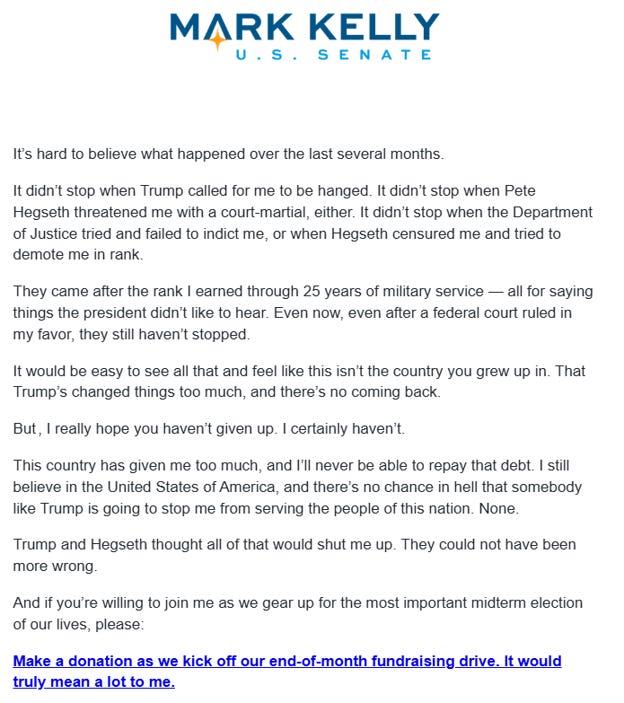
It was not the accusation embedded in the sentence, though there is one. It was something else, something I had to reflect on before I could name it. The statement is not an expression of hope. It is a demand for loyalty. And the target of that loyalty is not the American people or the American idea. It is the institution itself, the brand, the mythology, regardless of what the institution actually does to the people living inside it.
That is the thing that made me angry. The framing places the moral weight entirely on me. My commitment is what is being evaluated. Not the conduct of the country. Not what it has delivered, or failed to deliver, or actively taken from the people it was supposed to serve. Just whether I still believe. Whether I still have faith.
That is a theological demand, not a civic one. And I have become allergic to the theology.
Here is what I actually think about America, stated plainly. A country is not great because of its anthem or its mythology or the stories it tells about itself in textbooks and stadium ceremonies. A country is its people, its values, and the integrity of its institutions. When too many people excuse cruelty, corruption, and dishonesty, the country is morally degraded. There is no asterisk that fixes that. There is no amount of flag-waving that closes the gap between what a nation claims to be and what it actually does.
Look at what has actually happened. The Supreme Court looks compromised in ways that are not subtle. Congress proved too weak or too cynical to act as a check when it mattered most. Voting rules have been changed in ways that make accountability harder, not easier. The mechanisms the country built to remove bad actors from power are not functioning the way they were designed to function.
Below that, at the level of daily life, the record is not inspiring. The middle class has been hollowed out over decades. Healthcare is outrageously expensive and still routinely poor. Roads and basic infrastructure are neglected in ways that would embarrass a much smaller and less wealthy nation. Gun violence has become something the country treats as weather, something that just happens, something to absorb rather than prevent.
For an enormous number of Americans, the country has not been good to them. Not ambivalently good, not unevenly good. Not good. The young are handed a bill they did not run up. College, if it is still relevant after the next decade reshapes the economy, costs what a house used to cost. Houses cost what several houses used to cost and most young people will not own one. Social security comes out of every paycheck and the honest projection is that many of them will never collect what they paid in. Healthcare costs alone are enough to financially destroy a family that was doing everything right.
For the poor the situation is not a policy failure, it is an ongoing moral catastrophe. For minorities the abuse is not historical, it is structural and it is current. And right now the federal government is engaged in a project of taking from people who have the least and directing it toward people who have the most, with the blessing of every institution that was supposedly built to prevent exactly that.
So when someone asks me whether I have given up on America, what exactly are they asking? Are they asking whether I still believe in the people, most of whom are trying to live decently under conditions that keep getting harder? Yes, I believe in them. Are they asking whether I still think the original ideas were worth something? Yes. Are they asking whether I still love the country I came up in? In a complicated way that I could spend a long time explaining, yes.
But I do not think that is what they are asking. I think they are asking whether I will continue to offer the institution the benefit of the doubt. Whether I will keep deferring my honest assessment in favor of the story. Whether I will perform optimism when the evidence does not support it.
And here is the part I have to be honest about. The country was good to me. I built things, I took risks, I made money, I had a run that very few people anywhere in the world could have had. The system as it existed worked for me. Which means that when someone asks me not to give up on America, there is a particular kind of pressure in that ask. It is directed at my gratitude. It is asking me to take my good fortune and use it as a reason to stop seeing clearly.
That is the sharpest version of why the sentence made me angry. Patriotism without honesty is not patriotism. It is self deception with better branding. If I use my own comfortable outcome as a reason to stop accounting for what the system did to everyone who did not have my outcome, I am not being loyal. I am being complicit. Those are not the same thing, and I am not willing to confuse them.
Giving up on America would mean turning away, losing interest, ceasing to care what happens. I have not done that and I am not going to. But refusing to lie about what I see is not giving up. It is the only way any of this gets better. The country does not need more people willing to perform belief in it. It needs more people willing to tell the truth about it.
Mark—I still support you, but this is a turd of a message.